
A busy Jakarta fair, families joining the decision and a growing set of Asian alternatives suggest Indonesian students are comparing more options than before.
Education fairs rarely settle questions about a market, but they can show what prospective students are asking about. At a recent fair in Jakarta, the hall was busier than I had expected, and conversations covered a good mix of undergraduate and postgraduate prospects. One event cannot establish a market-wide trend, yet it offered an encouraging signal for destinations competing for these students, which is that interest in studying abroad appears to be coming from more than one student segment.
Conversations with Indonesian education agents added two observations that help explain who is asking and what they are comparing. Some agents are meeting more young families who see an overseas degree as a decision for the whole household, and agents also reported growing student interest in China and Taiwan. Taken together, these points suggest that the market is changing both in who makes the decision and in which destinations sit alongside Canada, the United States and Ireland in the comparison.
The wider numbers give these impressions some context. About 62,800 Indonesian students were studying abroad at tertiary level in 2022, 29 percent more than in 2017, and ICEF lists Australia, Malaysia, the United States, Japan and the United Kingdom among the leading destinations, with Canada outside that group. Canada is therefore a smaller destination for Indonesian students than the volume of conversation at a fair might imply, which makes the direction of travel more useful than the absolute count. The sections below look at that direction in Canada, the United States and Ireland in turn, then at the family decision across the three, and then at the regional alternatives.
Canada’s Indonesian numbers have held steady
Starting with Canada itself, IRCC data on study permits taking effect for Indonesian nationals show a gradual build rather than a surge (Figure 1). The count rose from 740 in 2015 to 1,285 in 2019, recovered after the pandemic to a peak of 1,730 in 2023, and then eased to 1,430 in 2024 and 1,380 in 2025. The first half of 2026 was up about 10 percent on the same months of 2025, although the figures are preliminary and can include renewals, so they are better read as direction than as a count of new students. Intake is also seasonal, with roughly half of 2025’s permits taking effect in the third quarter, so the first-half comparison is an early signal rather than a conclusion.
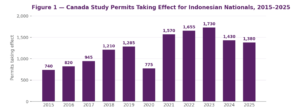
Figure 1 — Canada study permits taking effect for Indonesian nationals, 2015 to 2025. Data from IRCC study permit holder data, January 2015 to June 2026.
The fall of about 20 percent between 2023 and 2025 is mild next to India’s 66 percent and the 38 to 41 percent declines for Malaysia, Thailand and the Philippines, though Vietnam’s 9 percent was smaller still (Figure 2). Indonesia has therefore held up better than several regional peers while remaining below its 2023 level, which fits an impression of steady interest rather than a rebound.
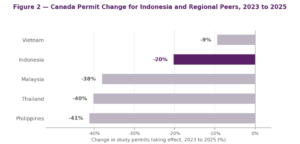
Figure 2 — Change in Canada study permits taking effect, 2023 to 2025, for Indonesia and selected Asian markets. Data from IRCC study permit holder data, January 2015 to June 2026.
The United States offers a larger but slowly shrinking base
The United States hosts a larger Indonesian student population than Canada’s permit counts imply, though it has edged down for two years running. Open Doors lists 8,104 Indonesian students in 2024/25, down 2.9 percent from 8,348 in 2023/24 and 8,467 the year before, and about 0.7 percent of all international students in the country (Figure 3). Within the 2023/24 total, short-term exchange students rose 28.6 percent on the back of Indonesia’s IISMA program and graduate and work-study categories rose 10 percent, which suggests that the headline figure masks different movements by level and that part of the base is short-term rather than degree-seeking.
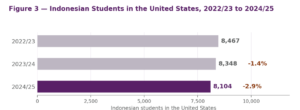
Figure 3 — Indonesian students in the United States, 2022/23 to 2024/25. Data from IIE Open Doors 2024 and 2025.
Policy has added uncertainty. The United States paused new student visa interview scheduling worldwide in late May 2025 to introduce social media vetting, and ICEF reports that study visas issued fell 23 percent overall in 2025. Country-level 2025 visa figures for Indonesia were not available in the sources reviewed, so the effect on Indonesian applicants remains unmeasured, and the 2025/26 Open Doors release will be the first full enrollment reading since those changes.
Ireland is growing, but Indonesia is not yet visible in the data
Ireland’s international enrollment reached nearly 45,000 in 2024/25, up just over 10 percent and the fourth consecutive year of growth, according to ICEF. The base is almost evenly split between undergraduates (22,825) and postgraduates (21,710), a balance that points to demand for both levels of study. India, the United States and China are the three largest source markets at 20.6, 13.8 and 9.9 percent of enrollment, and Indonesia is not separately reported in the sources reviewed. Ireland’s growth therefore says little about Indonesian demand specifically, and the gap is itself informative, since it suggests that Indonesia remains a small and largely unmeasured market there.
A postgraduate decision can be a family decision
For a prospective master’s student with a partner and children, the program is only one part of the choice. Families may also ask whether a partner can work, where their children can attend school, and whether the household can afford the move. The three destinations answer those questions differently (Table 1), and the differences are large enough to shape which country a household shortlists.
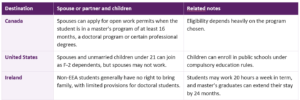
Table 1 — Family provisions for international students by destination. Data from Canada.ca, university F-2 guidance and Citizens Information Ireland.
Cost adds to the same calculation. ICEF’s November 2025 report notes that the rupiah had weakened by roughly 7 percent over the previous 12 months and that youth unemployment stood near 16 percent, which gives questions about total costs and career outcomes extra weight in a population where about 41 percent are under 24. Recruitment conversations in each destination may therefore need to address practical family questions alongside academic and career outcomes.
Competition is expanding within Asia
Agents in Jakarta also raised China and Taiwan as destinations appearing more often in student conversations. That feedback is a reason to investigate the shift, though it does not by itself measure how quickly demand for either destination is growing across Indonesia.
Taiwan offers one useful data point, and it is about scale more than momentum. ICEF reports 18,740 students from Indonesia in Taiwan in 2025/26, down 3 percent even as Taiwan’s total international enrollment rose 17 percent, and Taiwan’s representative in Indonesia has put the current figure at more than 19,000. Indonesia is Taiwan’s second-largest source of students after Vietnam, and the count is larger in absolute terms than the US figure, although counting bases differ between destinations. Over the latest year, however, Taiwan’s 3 percent dip sits close to Canada’s 3.5 percent and the US 2.9 percent, while Ireland cannot be placed on the same footing without Indonesian figures (Figure 4).
Focus Taiwan reports that 86 Indonesian students received Taiwan government scholarships in 2026 from more than 1,200 applicants, which suggests demand is running well ahead of places funded under that scheme. ICEF notes that Asian destinations offer savings through proximity alongside a robust set of top-ranked universities, and Taiwan has set a target of 320,000 international students by 2030.
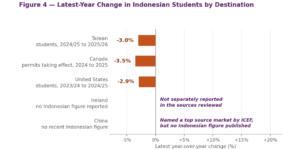
Figure 4 — Latest-year change in Indonesian students by destination. Measures differ, with students counted in Taiwan and the United States and permits taking effect in Canada. Data from ICEF Monitor, IIE Open Doors and IRCC.
I would treat the China observation as emerging agent feedback until comparable Indonesian student data is verified. ICEF reports roughly 380,000 international students in China in 2024/25, up 96 percent from the 2021 low, and names Indonesia among its top source markets in recent years, but an Indonesian figure was not published in the sources reviewed, and the last widely reported number is roughly 15,000 to 15,800 in 2019. Even at this stage it is a prompt to ask better questions about which students are considering these destinations, what programs interest them, and how they compare cost, scholarships, distance and career prospects with Canada, the United States and Ireland.
What the picture may mean for Canada, the United States and Ireland
My Jakarta visit does not yet justify a claim that Indonesian demand is rising overall for any of the three destinations. In Canada, permits sit about 20 percent below their 2023 peak despite a modest improvement in early 2026, the United States shows a slowly shrinking base with added visa uncertainty, and Ireland’s rapid growth has not yet been traced to Indonesia. It does suggest an opportunity worth following systematically. The mix of undergraduate and postgraduate enquiries at the fair calls for distinct messages for each group. School counsellor relationships may be important for undergraduate recruitment, while postgraduate prospects, particularly those moving with family, may need more detailed guidance on program length, total costs and dependent eligibility, and often use the services of agencies.
Because the three destinations treat dependents so differently, clear information on those rules may be part of what families weigh alongside the Asian options now entering the conversation. Several developments would sharpen the picture over the coming year, including whether Canada’s early 2026 improvement holds through the third quarter when Indonesian permits are usually highest, what the 2025/26 Open Doors release shows for the United States, whether Irish sources begin to report Indonesia separately, and whether verified data on Indonesian students in China become available. Until then, steady Canadian numbers, a slowly shrinking US base, an unmeasured Irish market and a large Taiwanese market that is not yet growing are best read as a market where more choices are being compared rather than one where interest has simply moved.
Sources include IRCC open data on study permit holders by country of citizenship, January 2015 to June 2026 (preliminary); IIE Open Doors 2024 and 2025 Fast Facts and Jakarta Globe reporting on Open Doors 2024; ICEF Monitor on Indonesian outbound mobility, November 2025, on Southeast Asian students and regional destinations, February 2024, on Irish enrollment, March 2026, and on US study visa issuance, August 2026; IDN Financials on the May 2025 US visa pause; Citizens Information Ireland; university F-2 dependent guidance; ICEF Monitor on Taiwan, August 2026; Focus Taiwan and Taipei Times, July 2026; ANTARA News, January 2020; and Canada.ca guidance on spousal open work permits.