
Brazil is the largest source of internationally mobile students in Latin America and, unlike many source markets, is not tied to one destination. UNESCO data compiled by ICEF count 89,150 Brazilian tertiary students abroad, ahead of Mexico at 56,910 and Colombia at 34,780, and they are distributed in comparable numbers across Argentina, Australia, Portugal, the United States and Canada (Figure 1). ICEF dates that total to 2020, whereas PIE News cites a UNESCO figure of about 89,000 for 2022, so the sources agree on the scale but differ on the year. This dispersion matters because a shift in conditions in any one destination is more likely to redirect Brazilian students than to end their plans to study abroad.
This article covers where Brazilian students go, what shapes demand at home, how price and currency set the pace, and what the mix of study levels shows.
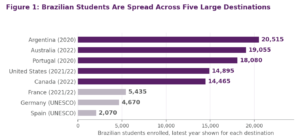
Figure 1: Brazilian students enrolled abroad by destination. Data from UNESCO Institute for Statistics as compiled by ICEF Monitor, April 2023. Years differ by destination.
A destination map with no single center
Recent national data confirm the spread. Portuguese higher education enrolled 18,271 students of Brazilian nationality in 2024/25, roughly 23 percent of about 80,000 foreign students, according to Pordata data reported by Jornal Económico. That count includes everyone of Brazilian nationality, and the narrower DGEEC count of degree mobility students, who moved to Portugal to study, is 12,211. Brazilians are the largest foreign group on either measure, ahead of Guinea Bissau on the DGEEC count and Angola on the Pordata count. The United States hosted 17,277 Brazilian students in the same year, up 2.4 percent on the prior year, which places Brazil tenth among its origin countries. Canada issued permits that took effect for 6,170 Brazilian nationals in 2025. Australia granted 1,916 visas to Brazilians applying from abroad in the second half of 2025, the United Kingdom granted 716 in 2025, and Ireland draws a large English language market. The figures use different measures and should not be added together, but Figure 1 and Table 1 show that no destination dominates.
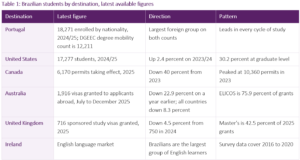
Sources: Pordata via Jornal Económico; IIE Open Doors; IRCC; Australian Department of Home Affairs; UK Home Office; Bloomberg Línea.
Canada shows pressure, though less than the global drop
IRCC data on study permits taking effect for Brazilian nationals rose from 6,345 in 2015 to 10,360 in 2023, then fell to 7,005 in 2024 and 6,170 in 2025 (Figure 2). That is 40 percent below the 2023 level, compared with 44 percent for all countries together, 45 percent for Colombia and 30 percent for Mexico. The first two quarters of 2026 add up to 2,540 permits against 2,490 in the same quarters of 2025, an increase of 2 percent, but the third quarter normally supplies the most permits (about 37 percent of the 2025 quarterly total), so the half year is an early signal and not a conclusion. IRCC counts can include renewals, and the 2026 figures are preliminary.
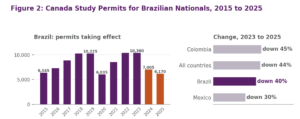
Figure 2: Canada study permits for Brazilian nationals. Data from IRCC study permit holder data, January 2015 to June 2026, preliminary.
The United States is steady and leans toward graduate study
Open Doors shows Brazilian enrollment in the United States dipping to 14,000 in 2020/21 and then rising each year to 17,277 in 2024/25, which is 2.4 percent above 2023/24 and 3.6 percent above the pre pandemic level of 16,671 in 2019/20 (Figure 3). Undergraduates made up 8,590 of the 2024/25 total and graduate students 5,210, a figure that rose 3.6 percent year on year. Together they account for 13,800 of the 17,277 students. The remainder is 2,767 students on Optional Practical Training and 710 in non degree programs, which Open Doors counts in the total.
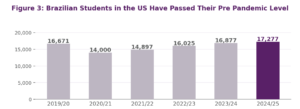
Figure 3: Brazilian students in the United States. Data from IIE Open Doors, 2025 Brazil fact sheet.
Demand at home is large, digital and led by language
Brazil’s domestic system is large and growing. The 2024 higher education census counted 10,227,226 students, 2.5 percent more than in 2023, with distance learning accounting for 50.7 percent of undergraduate enrollment and 2,244 of the 2,561 institutions in private hands. About 33 percent of the 2023 high school graduating class entered higher education in 2024. Capacity at home is therefore not the main constraint, and the reasons for going abroad appear to lie elsewhere.
A February to April 2026 BELTA survey of more than 2,200 Brazilians and 74 education agencies, reported by ICEF, shows where. About 70 percent of respondents plan to study abroad, 85 percent have already had an international education experience, and 68 percent of past study was in English. Language learning was the preferred program for 46 percent, including 26 percent who wanted language courses that allow temporary work, while degree study attracted about a quarter, split evenly between undergraduate and postgraduate (Figure 4). Agents ranked undergraduate and graduate placements only sixth and seventh among their products. Because UNESCO counts students enrolled at tertiary level, this language and short stay activity sits largely outside the totals in Figure 1.
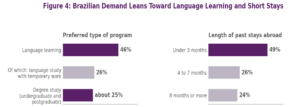
Figure 4: Brazilian student preferences and past stays. Data from BELTA surveys of February to April 2026 as reported by ICEF Monitor, June 2026.
Price and currency set the pace
The same survey shows how sensitive the market is to cost. Among agents, 53 percent sent more students in 2025 than in 2024, 17 percent about the same and 30 percent fewer, with average placement growth of 9.5 percent, and 73 percent expect more students in 2026 (Figure 5). A favorable exchange rate was the most cited reason a sale closed, currency devaluation was the main reason it failed, and five of the ten most common reasons for students dropping a placement were financial.
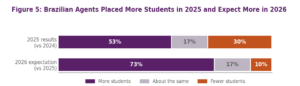
Figure 5: Brazilian education agents’ placement trends. Data from BELTA agent survey, February to April 2026, as reported by ICEF Monitor.
The currency path explains the timing. The real lost 21.82 percent against the dollar in 2024, gained 12.54 percent in 2025 and had gained a further 10.19 percent by October 7, 2026, according to Poder360 and the Elos Ayta consultancy (Table 2). The 2024 shock came just before the weaker 2025 results for Canada and Australia, which is consistent with a delayed effect, although policy changes in those countries make it impossible to separate the causes. If the stronger real holds, conditions for 2027 intake would be easier than those for 2025, and the BELTA authors warn that renewed weakness would reverse that.
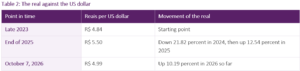
Source: Poder360, citing Elos Ayta analysis of PTAX rates.
The level of study is shifting at the margins
Postgraduate study looks underdeveloped relative to Brazil’s size. Instituto Trajetórias estimates that nearly 30,000 Brazilian master’s and doctoral students were abroad in 2022, against about 52,000 that population and income would predict by comparison with other emerging countries, which ranks Brazil seventh in that group. Open Doors data for the United States show movement at the margins rather than a surge (Table 3). Undergraduate enrollment grew 4.6 percent year on year, graduate enrollment grew 3.6 percent, and non degree enrollment fell 17.9 percent. In the United Kingdom, Home Office data show master’s study falling from 48.7 percent of Brazilian sponsored study visa grants in 2022 to 42.5 percent in 2025, while bachelor’s study rose from 26.0 to 31.1 percent.
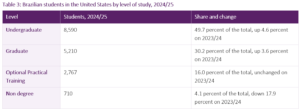
Sources: IIE Open Doors 2025 Brazil fact sheet.
What the pattern suggests
Taken together, the evidence describes a diversified and price sensitive source market. Brazilian students are present in at least five large destinations, a large share of activity consists of short, language based stays, degree flows to the United States and Portugal are steady, and Canadian study permits fell by less than the drop across all countries between 2023 and 2025, and Australian visa grants to Brazilians applying from outside the country fell faster than the all country rate in the second half of 2025. Postgraduate study remains below what the market’s size would suggest, and the exchange rate appears to set the pace of growth in every segment.
Three questions would sharpen the picture over the coming year: whether the third quarter of 2026 confirms the early rise in Canadian permits, what the 2025/26 Open Doors release shows for the United States, and whether the recent strength of the real carries through to 2027 placements.
Sources include ICEF Monitor on outbound mobility trends for Brazil, Colombia and Mexico, April 2023, drawing on UNESCO Institute for Statistics data, and on new Brazilian surveys, June 2026; IRCC open data on study permit holders by country of citizenship, January 2015 to June 2026 (preliminary); IIE Open Doors 2025 fact sheets for Brazil, Mexico and Colombia; Australian Department of Home Affairs report BR0097 to December 31, 2025; UK Home Office sponsored study visa grants to main applicants outside the UK, year ending March 2026 (provisional from 2025); Pordata data reported by Jornal Económico and DGEEC enrollment statistics on foreign students in Portugal, 2024/25; Inep Higher Education Census 2024 as reported by Bahia Notícias; Instituto Trajetórias on Brazilian postgraduate students abroad; Bloomberg Línea on Brazilian students in Ireland; and Poder360 on the real and the dollar, October 2026.