

The Gulf is a small source of students for Canada, the United States and Ireland, while Dubai in particular is a fast growing competitor for the international students they recruit. Dubai and Doha have built education hubs around international partner universities, and the question for Canadian, American and Irish institutions is whether those hubs now keep Gulf students at home instead of sending them abroad. The official data point to a more nuanced answer. Emirati citizens are a small share of Dubai’s enrolment, and Emirati and Qatari citizens were already a small part of what Canada and the United States received. The more important competition is for the international students whom the hubs recruit, many of them students that Canadian and Irish institutions also want. This article uses data from Dubai’s regulator, Qatar’s ministry, UNESCO, ICEF Monitor, IIE Open Doors and Immigration, Refugees and Citizenship Canada (IRCC).
Dubai’s growth is large, international and fast
Dubai’s Knowledge and Human Development Authority (KHDA) reports that private higher education enrolment reached 42,026 students at 41 institutions in 2024/25, up 20 percent, and 50,690 in 2025/26, up 20.6 percent (Figure 1). International students, defined as those who came to Dubai specifically to study, made up 35 percent of the 2024/25 student body, and their numbers grew by 29 percent in that year, faster than total enrolment. Dubai’s stated goal is for international students to reach 50 percent of enrolment by 2033. Of the 41 institutions, 37 are international campuses.
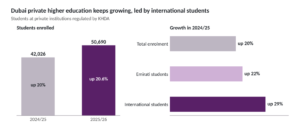
Figure 1: Dubai private higher education enrolment and growth, KHDA 2025/26
Most of Dubai’s students are not Emirati nationals. The 2025/26 report counts 4,760 Emirati students, about 9 percent of enrolment. UNESCO data reported by ICEF Monitor point the same way at national level: the UAE hosted 237,034 international students in 2023, more than four times the 54,162 it reported in 2012. The same UNESCO report, as summarized by ICEF Monitor, finds that in most reporting Middle Eastern countries the majority of international students come from within the region, and it names Qatar among the countries where this is especially pronounced.
Qatar’s hub is smaller and anchored in national policy
Qatar’s Ministry of Education and Higher Education reports 52,564 higher education students, of whom 47,326 are undergraduates and 5,238 are postgraduates, across about 27 institutions (Table 1). Education City brings together eight universities, including the Carnegie Mellon, Virginia Commonwealth, Northwestern and Weill Cornell campuses alongside Hamad Bin Khalifa University. In the class of 2026, 444 of about 1,100 Education City graduates were Qatari and 660 came from 78 countries, according to figures carried by the Qatar News Agency. The ministry also cites overseas scholarships among the options for Qatari youth and announced its 2026/27 government scholarship plan on April 21. The public universities look different from Education City: at Qatar University’s latest graduating cohort, more than 2,500 of 4,024 graduates were Qatari, while Qatari students make up 25 percent of the more than 9,000 students at the University of Doha for Science and Technology (UDST). None of these sources gives a count of Qatari students studying abroad.
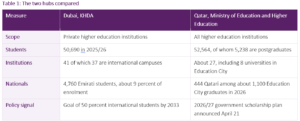
Sources: KHDA 2025/26 landscape report and May 2025 release; Qatar Ministry of Education and Higher Education data reported by the Qatar News Agency.
Study abroad from the Gulf is small and has not moved in step
If the hubs were drawing Gulf students home, American numbers should show a steady decline. Qatar’s do, while the UAE’s have recovered (Figure 2). Open Doors counts 350 Qatari students in the United States in 2024/25, down from 1,127 in 2017/18, a fall of 69 percent, although Education City opened in 1998, so its decline cannot be pinned on recent hub expansion. Emirati students fell from 2,486 to 1,502 by 2022/23 and then rose to 1,808 in 2024/25, up 15.1 percent in the latest year and still 27 percent below 2017/18.
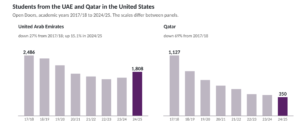
Figure 2: International students from the UAE and Qatar in the United States. Data from IIE Open Doors 2026 fact sheets for the United Arab Emirates and Qatar.
Open Doors 2026, released on November 16, 2026, puts total US international enrolment at 1,146,163 in 2025/26, down about 3 percent. Canada tells a smaller story because the numbers are tiny. IRCC data show 160 study permit holders with Emirati citizenship and 10 with Qatari citizenship taking effect in 2025, against 380,680 for all countries (Table 2). Together they are about 0.04 percent of Canada’s total, so growth in the Gulf hubs cannot explain Canada’s 44 percent fall since 2023. A caution applies: both datasets count by citizenship, and only about 9 percent of Dubai’s private higher education students are Emirati, so any effect of the hubs on resident expatriate families would be recorded under other countries’ passports.
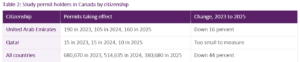
Source: IRCC study permit holders by country of citizenship, January 2015 to June 2026, preliminary.
What the hubs recruit matters more than what they retain
The more direct overlap is in recruitment. KHDA lists the home countries of Dubai’s 41 providers as the United Kingdom (8), India (6), the UAE (5), France (5), Australia (5), the United States (3) and a handful of others, and none is from Canada or Ireland (Figure 3). India is the largest nationality in KHDA’s student list at 43.5 percent, although the report does not state whether that share covers all students or only international ones. Meanwhile, IRCC’s count of Indian study permit holders fell from 277,945 in 2023 to 93,765 in 2025, down 66 percent. Open Doors 2026 shows a smaller decline in the United States, where Indian enrolment was 339,435 in 2025/26, down 6.5 percent. These facts do not prove diversion, but they show Dubai building capacity in a market where Canada has lost a great deal of volume.
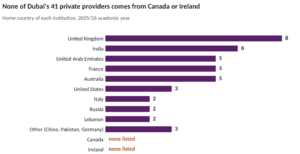
Figure 3: Home country of Dubai’s 41 private higher education providers. Data from the KHDA 2025/26 higher education landscape report.
Implications for Canadian, American, and Irish institutions
The hubs are better seen as rivals for international students than as replacements for Gulf demand. Canadian and Irish recruiters should expect Dubai to compete for the same pool, Indian students included, rather than to absorb Emirati or Qatari applicants, who were never numerous. Ireland is not measured here, because the Irish government’s published visa data by nationality do not separate study visas, and no other comparable series was found. The hubs may yet change this picture, but the data so far do not show that they have. The practical test for institutions in Canada and Ireland is therefore less about whether Gulf nationals stay at home and more about whether the hubs’ international intake keeps growing at the pace KHDA reports.
For American institutions the lesson is similar: Emirati and Qatari students numbered 1,808 and 350 in 2024/25, a small fraction of the more than 1.1 million international students Open Doors counted in the United States in 2025/26, so the larger opening is the international intake the hubs recruit, not the nationals they might retain.
Turning the hubs into a recruitment advantage
Recruitment from the two countries is best approached as a targeted effort. Canada’s 160 Emirati and 10 Qatari permit holders in 2025 show that volume will not come from nationals alone. The first move would be to partner with the hubs instead of competing with them, through articulation, transfer and joint program agreements with the institutions where Gulf students already study, since no Canadian or Irish provider is among Dubai’s 41. The second is to widen the target from citizens to everyone studying in Dubai, where international students made up 35 percent of enrolment in 2024/25, and where Indian students are the largest nationality in the student list. The third is to focus on the segments where study abroad is still valued, starting with Emirati students, whose numbers in the United States have recovered to 1,808, and to follow Qatar’s 2026/27 scholarship plan, announced on April 21, for any overseas component.
Sources include KHDA, Dubai, press release of May 19, 2025 and 2025/26 higher education landscape report; Qatar Ministry of Education and Higher Education data reported by the Qatar News Agency, May 10, 2026; UNESCO Higher Education Global Trends Report as reported by ICEF Monitor, May 21, 2026; IIE Open Doors 2026 fact sheets for the United Arab Emirates and Qatar; IIE Open Doors 2026 Fast Facts, released November 16, 2026, for total US international enrolment and Indian students; VCU Magazine, fall 2023, for the 1998 opening of VCUarts Qatar in Education City; and IRCC open data on study permit holders by country of citizenship, January 2015 to June 2026 (preliminary). Irish visa data by nationality (Department of Justice, Home Affairs and Migration) were reviewed but do not separate study visas.