
For anyone outside the Chinese study-abroad market, Canada’s recent policy changes are easy to misread as a simple retreat. Study permits are being capped, financial requirements are tighter, and the language around temporary residents has become noticeably cooler. But the more accurate reading is that Canada is changing the filter, not shutting the door. The country still wants international students. It just wants a different mix of them.
That shift is now visible in how Chinese families are responding. The old pitch was straightforward: a Canadian degree, a well-known campus, and a path to work. The new pitch requires a spreadsheet. Families are asking which level of study gets priority, whether a program leads to a post-graduation work permit, whether a co-op placement is actually guaranteed, and what the whole thing costs after scholarships and living expenses.
EIC Education, one of China’s larger study-abroad agencies, released its tenth annual Canadian study guide in Beijing on August 1. The report, based on data from Immigration, Refugees and Citizenship (IRCC) Canada, Statistics Canada and university annual reports, plus the agency’s own 2026 fall intake applications, offers a useful window into that calculation.

The policy pivot is real, but it is selective
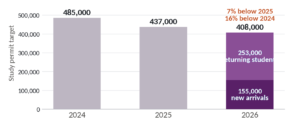
Canada plans to issue at most 408,000 study permits in 2026, including 155,000 for new arrivals. That is about 7% below the 437,000 targets for 2025 and 16% below the 485,000 targets for 2024. The intent is not mysterious: Canada wants to ease pressure on housing, healthcare and campus capacity, while directing education resources toward applicants with clear study goals, higher-quality program choices and skills that match labor demand.
Figure 1. Canada’s study permit targets stepping down for 2026
The provincial attestation letter, or PAL, has become the practical gatekeeper. Undergraduate and college applicants generally still need one. But from January 1, 2026, eligible applicants to public master’s and doctoral programs, as well as some younger students, can be exempt. That detail matters. Canada is not treating all international students the same. It is making public graduate study easier to access while keeping tighter limits on routes that have been associated with weaker outcomes.
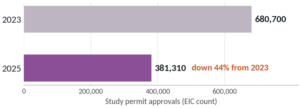
The approval numbers show the squeeze already under way. By EIC’s count, international study-permit approvals fell from 680,700 in 2023 to 381,310 in 2025. For mainland Chinese applicants, new approvals in 2025 were about 49,000, down roughly 13% year on year. By the end of 2025, there were about 82,946 mainland Chinese study-permit holders in Canada, or 12% of the international student population.
Figure 2. Study permit approvals have almost halved since 2023
That is a decline, but not an exodus. Chinese students remain a core source of talent for Canadian universities. At the University of Toronto, mainland Chinese students make up nearly half of international undergraduates and graduate students. At UBC, they account for about 30% of international students. McGill and Queen’s still count them among their most important international cohorts. What is shrinking is the speculative applicant: the family that once treated a Canadian application as a low-commitment option. What remains is more deliberate.
Table 1. Where Chinese students remain a core cohort

Chinese families are shopping differently
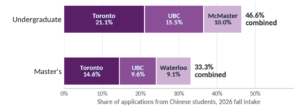
The change in application behavior is more revealing than the headline decline. In EIC’s 2026 fall intake data, the top three undergraduate destinations are still the University of Toronto (21.1%), UBC (15.5%) and McMaster University (10.0%), together accounting for 46.6%. At the undergraduate level, brand still sells.
At the master’s level, the concentration loosens. Toronto, UBC and Waterloo account for 14.6%, 9.6% and 9.1% of applications respectively. Universities such as Windsor, Brock and Ottawa are drawing more attention. That does not mean Chinese families have suddenly stopped caring about rankings. It means rankings are no longer the only column in the spreadsheet. Program design, admission feasibility, internship access, local industry and post-study pathways now sit alongside prestige.
Figure 3. Applications spread out beyond the top three at master’s level
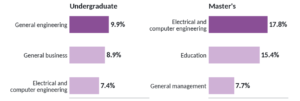
The field choices tell a similar story. Undergraduates are gravitating toward general engineering (9.9%), general business (8.9%) and electrical and computer engineering (7.4%). At the master’s level, electrical and computer engineering leads at 17.8%, followed by education at 15.4% and general management at 7.7%. These are not purely academic choices. They are bets on employability.
Figure 4. Field choices lean toward employability
Canada’s “AI for All” strategy, which aims to support up to 250,000 new jobs through AI applications by 2031, has reinforced interest in AI-adjacent fields. But the report makes a sensible point: students should look at the actual curriculum, internship structure and industry partnerships, not just the word “AI” in a program title. Toronto has combined AI with data science, health and urban sustainability, and its MScAC program emphasizes applied training and industry practice. McGill leans on Mila and its medical research base to connect AI with life sciences and social sciences. UBC links computing to cognitive systems, natural resources, urban forestry and computational linguistics. Waterloo uses its computer science, mathematics, engineering and co-op system to push AI toward engineering application.
Co-op is popular, but access is not automatic
Co-op is one of Canada’s strongest selling points, and the paperwork has become easier. From April 1, 2026, eligible internships that are a mandatory part of a program no longer require a separate co-op work permit. That removes a bureaucratic step, but it does not remove the competition.
The entry rules vary widely. Some popular Waterloo programs require students to choose co-op at the point of undergraduate application, with eligibility decided alongside admission. Some McMaster programs require students to meet a GPA threshold and pass a résumé or interview screen after enrollment. At Simon Fraser and the University of Victoria, many programs allow students to apply after starting or enter through the normal study plan. For Chinese families, the useful question is no longer “Does this program have co-op?” It is “When do I apply, is entry guaranteed, how competitive are the placements, and what extra costs are involved?”
Table 2. Co-op entry works differently at each university

Graduate study is where the policy red carpet is
The clearest policy benefits now sit at the master’s and doctoral level. From January 1, 2026, eligible applicants to public master’s and doctoral programs can skip the PAL. Eligible PhD applicants and their accompanying family members can also receive priority processing.
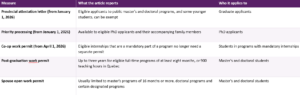
Post-graduation work permits are another draw. Eligible full-time master’s and doctoral programs of at least eight months, or 900 teaching hours in Quebec, can generally lead to a post-graduation work permit of up to three years, even if the total program is shorter than two years. Spouse open work permits are usually limited to students in master’s programs of 16 months or more, doctoral programs and certain designated programs.
Table 3. The 2026 policy settings that favor graduate study
The cost side is more attractive than many families expect. Statistics Canada data put average international graduate tuition at about CAD 24,028 in 2025/26, roughly 42% lower than the international undergraduate average. Ontario averages about CAD 28,624, British Columbia CAD 26,607 and Quebec CAD 23,587. Research-based graduate students can also receive scholarships, research assistantships or teaching assistantships. Among EIC’s doctoral admissions through June 2026, 24 offers included 13 full scholarships and two partial scholarships. The federal CGRS scholarship has also been raised: the master’s award rose from CAD 17,500 to CAD 27,000 a year, an increase of 54.3%, while the doctoral award rose from CAD 35,000 to CAD 40,000, up 14.3%.
Figure 5. Graduate study costs less than many families expect
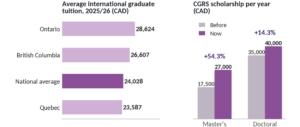
Figure 6. Funding appears in more than half of EIC’s doctoral offers

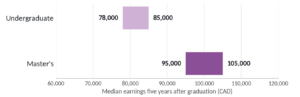
The earnings data gives these numbers a longer horizon. Five years after graduation, median incomes for graduates in health, engineering, and mathematics/computer and information sciences tend to rank near the top. For undergraduates in those fields, median earnings are around CAD 78,000 to 85,000; for master’s graduates, around CAD 95,000 to 105,000. That premium is why graduate study has become, for some Chinese families, less of an academic detour and more of a career strategy.
Figure 7. Master’s graduates earn a premium five years on
The 2027 to 2029 levels plan confirms the pattern
Immigration, Refugees and Citizenship Canada (IRCC) published the 2027 to 2029 Immigration Levels Plan on November 5, 2026, alongside Budget 2026. Some coverage has framed it as a rise in permanent immigration, but the plan itself describes stabilization: permanent resident admissions are set at 380,000 a year for 2027, 2028 and 2029, in line with the previous plan, and economic class admissions stay above 64 percent of the total. The one new element is a time limited measure to transition up to 200,000 people already in Canada to permanent status in 2027, in two cohorts of up to 100,000 workers and up to 100,000 on humanitarian pathways.
For international students, the plan sets up to 150,000 new arrivals a year for 2027 to 2029, within total temporary resident arrivals of 370,000 a year that also include 220,000 new workers. That is slightly below the 155,000 new arrivals planned for 2026. IRCC says permanent admissions include people who are already working or studying in Canada, and it lists targeted measures for graduate students and researchers among its talent attraction priorities, which reinforces the graduate study route described above. Canada is not opening wider. It is holding the entry cap steady while directing permanent places to people who are already in the country.
Table 4. What the 2027 to 2029 levels plan sets
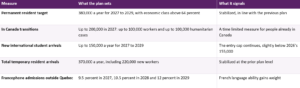
Source: IRCC backgrounder, Building a stronger Canada through a well managed, predictable immigration system, November 5, 2026.
For Canadian universities and policymakers, the signal from the Chinese market is not that demand has vanished. It is that demand has become more discriminating. A famous campus and the word “Canada” used to be enough to generate applications. Now families want to know whether the PAL is waived, whether the program is public, whether co-op is genuinely accessible, what scholarships exist, and how clear the path is from graduation to work.
Canada has changed its filter, and the 2027 to 2029 levels plan shows it intends to keep it in place. Chinese families have changed their arithmetic. Both are moving from expansion to selectivity, and this time the families are doing the math more carefully.