
In the region’s most agent-anchored markets, a new class of advisor is winning student trust and forcing institutions to rethink how they show up.
For many years, traditional education agents have been the primary channel connecting international institutions with prospective students. Their strong partnerships with universities and expertise in admissions continue to play an important role across Southeast Asia.
But the student changed before the industry did. Today’s applicants arrive already armed with university websites, social media, webinars, student ambassadors, and AI-powered research tools. The scarce commodity is no longer information about where a student can apply, it’s judgment about which pathway genuinely fits. That question is increasingly being answered by independent education counsellors (IECs): advisors not tied to representing particular institutions, who position themselves as career and education strategists rather than application processors.
A market built by agents
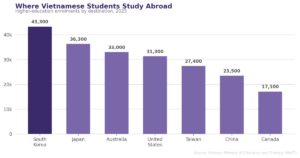
Southeast Asia is the world’s third-largest source of internationally mobile students, behind only China and India, with more than 350,000 students abroad and Vietnam alone accounts for the region’s largest share. Government figures put the total number of Vietnamese studying overseas above 250,000 in 2025, with roughly 150,000 in higher education across South Korea (43,300), Japan (36,300), Australia (33,000), the US (31,300), Taiwan (27,400), China (23,500) and Canada (17,100). Families are estimated to spend US$3–4 billion a year on overseas study over 90 percent of it self-funded.
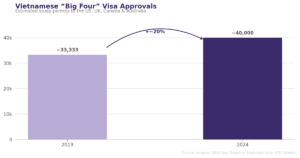
The growth has been sustained, not a one-off spike. Vietnamese study permit approvals to the “Big Four” destinations rose 16 percent between 2022 and 2024, with a further 14 percent forecast for 2025; roughly 40,000 Vietnamese students secured Big Four visas in 2024 alone, nearly 20 percent more than in 2019. Heading into 2026, forecasters expect Vietnam to remain one of the more resilient sending markets even as students widen their consideration set beyond the traditional big-name destinations.
That flow was built almost entirely on the traditional agent model. For two decades, recruitment agencies have been the connective tissue between Southeast Asian families and international institutions handling admissions, visas, documentation and pre-departure support end to end. The model still dominates, and the region’s counsellors are clear-eyed about why.
“There are two main types of independent counsellors in the market: those who build a personal brand on social media and attract students through online content and engagement, and former agency counsellors who leave to establish their own practice, relying on existing client networks and referrals. There is greater confidence in working with IECs who have previously handled student cases successfully while employed at an established agency. Counsellors whose reputation is based solely on social media presence are generally viewed with more caution unless they have demonstrated credibility and proven outcomes. Professional experience, a strong track record, and trust remain the most important factors when choosing to work with an independent counsellor.”
— Nguyen Thuy Duong, International Recruitment Representative, Fleming College
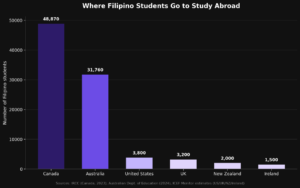
The pattern isn’t unique to Vietnam. The Philippines, meanwhile, is often described as a “migratory” market, the largest segment of students are more interested in emigrating and building new lives abroad with their families than in a specific degree. At least 80,000 Filipino students were studying abroad in 2023/24, based on Canada and Australia’s numbers alone, though another estimate puts the annual outbound total closer to 49,000, with postgraduate demand driving a projected 13% annual growth over the next five years.
Canada is the largest single destination. It hosted 48,870 Filipino students in 2023, up from 7,730 in 2019, a 567% increase. Australia is close behind with 31,760 Filipino students in 2024, up from 8,492 in 2019, a 274% increase. The US has fewer than 4,000 Filipino students, and the UK, New Zealand, and Ireland combined still trail either Canada or Australia individually. Separately, Filipino enrollment in US higher education only crossed 4,000 for the first time in 15 years in the 2023–24 academic year, per Open Doors.
So why is the ground moving?
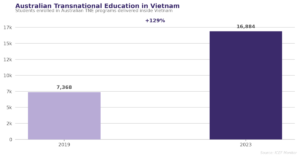
The data backs the instinct to look wider. A regional study found Japan and Korea now outpace the US, Australia and Canada in popularity among Vietnamese families, a function of affordability, institutional ranking strength and geographic proximity while enrolment in Australian transnational-education programs delivered inside Vietnam more than doubled, from 7,368 students in 2019 to 16,884 in 2023. Students are not simply choosing a country anymore; they are comparing pathways, and that comparison is exactly the terrain IECs have built their value on.
“Long-term established brands like IDP, CEI etc. are still well trusted and used by parents and students. Gen Z–alpha kids tend to get reference from online sources (IEC blogs, FB group posts, webinars, workshops, etc.). There’s a minor shift from traditional and big-name agencies to IECs, given that the consultant used to work for a big brand agency and already has an established network in the market. Still, the number is small in comparison to the dominance of the big brands with good reputation in the market at the moment.”
– Kim Nhan Ha, Regional Manager for Southeast Asia, Korea and Japan, Southern Alberta Institute of Technology (SAIT)
From application support to long-term career planning
Unlike traditional recruitment agencies, many IECs position themselves as career and education advisors rather than application processors. Their services often include:
- Career and personality assessments
- University and programme selection based on long-term career goals
- Country comparisons beyond tuition and visa requirements
- Guidance on employability, internships, and post-study opportunities
- Ongoing mentoring before and after enrolment
Parents are also becoming more willing to invest in these services, particularly for postgraduate applicants or families making significant financial commitments to overseas education. They increasingly view study abroad as a long-term investment rather than simply obtaining an overseas degree.
This trend mirrors broader changes seen in domestic education, where personalized tutoring, coaching, and mentoring services have experienced rapid growth over the past decade.
Who the independents are, and who gets trusted
The label covers two quite different categories.
“In the U.S. market, independent counsellors operate alongside traditional recruitment agencies. Unlike agencies, many independent counsellors do not receive commissions from institutions but instead charge students directly for their services. Their primary role is to provide impartial guidance, helping students develop an application strategy and apply to multiple institutions that best fit their goals. This model reflects a growing student-centered approach, where counselling is perceived as more independent and less influenced by institutional commission structures.”
-Hien Pham, International Recruitment Specialist for Southeast Asia at St. Thomas University
The US offers a preview of where Southeast Asia’s model can mature. Fee-for-service, commission-free advising is the fullest expression of the student-centered logic now taking root across the region and the credibility hierarchy Duong describes suggests Southeast Asian families are already applying similar scrutiny, greater trust for counsellors with a proven agency track record, more caution for those whose reputation is purely digital.
Social media is accelerating trust in independent voices
Another key driver is the changing digital landscape.
Students are increasingly discovering study abroad information through TikTok, Instagram, YouTube, and LinkedIn instead of relying on Facebook groups or agency websites.
Many independent counsellors have built strong personal brands by sharing:
- Day-in-the-life student content
- Honest discussions about visas and employment
- University comparisons
- Career advice
- Personal experiences from studying overseas
Their content often feels more authentic and less promotional than traditional marketing materials.
At the same time, many recruitment agencies across Vietnam report that student acquisition is increasingly driven by short-form video platforms such as TikTok and Instagram rather than Facebook, requiring organisations to rethink how they communicate with prospective applicants.
Complementary, not competing
None of this amounts to the displacement of agents.
“In Vietnam and Southeast Asia, traditional education agencies continue to dominate due to their established reputation, visa expertise, and comprehensive end-to-end support. Independent Education Counsellors (IECs) are becoming increasingly influential, particularly through social media and word-of-mouth referrals, as they are often perceived as more approachable and trustworthy. Students and parents are increasingly seeking a second opinion before making their final study destination or institution choice.”
– Thủy (Sophia) Dương, Market Representative for Southeast Asia, South Korea and Europe at Cambrian College
A typical applicant now stacks these layers – attending institutional webinars, following student creators, consulting an IEC on direction, and engaging an agency to execute the application with its official university training, real-time admissions updates and visa expertise intact. The recruitment ecosystem is not being replaced; it is being expanded, and the student sits at the center of more perspectives than ever, weighing multiple viewpoints before making one of the biggest financial and personal decisions of their lives.
For international institutions, this creates several opportunities:
- Build relationships beyond the agency channel i.e. credible IECs and career mentors now shape decisions upstream of any application.
- Invest in genuinely educational content, because the counselling conversation is won by information that helps families decide, not material that promotes.
- Lead with outcomes i.e. employability, industry connections, graduate ROI. Since these are the currencies of the career-focused advising IECs have made mainstream.
- Be present on the platforms where the decision actually forms i.e. short-form video first, legacy channels second.
In an increasingly competitive Southeast Asia, the institutions that support transparent, student-centered decision-making will compound trust and brand recognition over time.
Outlook: a hybrid market
The direction of travel is convergence. “Looking ahead, the market is likely to become more hybrid,” Duong forecasts, “with agencies investing more in counsellors’ personal branding, while IECs build strategic partnerships with institutions and larger agencies to remain competitive.” With Vietnam’s outbound numbers still climbing study permit growth outpacing pre-2019 levels and demand broadening into Japan, Korea and TNE pathways alongside the traditional Big Four, there is room in the market for both models to scale together rather than at each other’s expense. The differentiator becomes what it has always been for students choosing whom to trust with their future: credibility, demonstrated outcomes, and advice that puts the student’s trajectory ahead of anyone’s commission. The institutions and partners that understand this earliest will be the ones today’s most informed generation of students chooses to listen to.
Sources: Vietnam Ministry of Education and Training (MoET); Acumen 2024 Key Trends in Southeast Asia; ApplyBoard ApplyInsights; ICEF Monitor; IIE Open Doors 2024; UNESCO Institute for Statistics; practitioner interviews conducted by Worldwide EduConnect.