

From a handful of Kathmandu counselling offices to a 10,000-agency industry now facing its first real reckoning.
The Origins
International education arrived in Nepal through consultants with the liberalizing economy in 1990s. Small counselling offices in Kathmandu began connecting students to institutions in India, Japan and Australia. The sector organized early, registering the Educational Consultancy Association of Nepal (ECAN in 1997; after a dormant spell, its 2005 revival re-established it as the industry’s primary voice in policy dialogue with government.
The Boom
Nepal’s outbound mobility ratio stands at roughly 19 percent, nearly ten times that of India or China. The Ministry of Education, Science and Technology issued a record 112,593 No Objection Certificates (NOCs) in FY 2023/24 and over 123,000 in 2025, with more than 543,000 approved between 2018/19 and mid-2024/25. 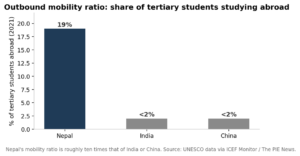
Figure 1. Nepal’s outbound mobility ratio dwarfs its far larger neighbors, making it a disproportionately important recruitment market.
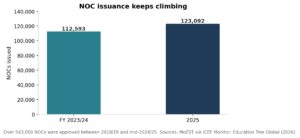
Figure 2. Annual NOC issuance has set successive records, crossing 123,000 in 2025.
Government estimates put the number of operating consultancies at around 10,000, roughly one for every eleven students who received an NOC last year. A few dozen established multi-branch agencies sit at the top (KIEC, NIEC, The Next Education, Search Education, AECC Nepal and others), competing on branch networks in Pokhara, Chitwan, Butwal and the Terai, on multi-destination capability, and on published visa success rates of 95–97 percent. Below them stretches a long informal tail of single-office operators.
How the Leading Agencies Compete
Five competitive levers dominate the market. Test preparation as an acquisition funnel. Virtually every major consultancy bundle IELTS, PTE, TOEFL, SAT, GRE and GMAT preparation with counselling. Test prep is not primarily a revenue line; it is a customer acquisition engine that captures students’ months before they choose a destination or institution, giving the consultancy first-mover influence over that decision. For Japan- and Korea-focused agencies, in-house JLPT and TOPIK classes play the same role. Geographic reach. Branch networks are a genuine moat. Demand has decentralized well beyond Kathmandu Valley into Pokhara, Chitwan, Butwal, Itahari, Biratnagar, Birgunj and the eastern Terai, and agencies with physical presence in these secondary cities capture students who prefer in-person documentation support. Several leaders have gone further, opening onshore offices in destination countries (Sydney is the most common) to service students’ post-arrival, a retention and referral play as much as a service one. Destination diversification. The “big four” – Australia, Canada, the UK and the US, still anchor the market, but policy volatility has made breadth the real differentiator. Each time a major destination tightens, demand doesn’t disappear; it redirects and interest is already spreading toward Ireland, Denmark, Finland, Germany, France, Japan and other non-traditional destinations. For Nepali students, the destination checks the boxes that matter most in the current climate
- English-medium study,
- A two-year post-study stayback for postgraduates, and
- Critically, a visa regime that has not turned hostile.
The profile of student now being rejected by Australia at scale is often precisely the profile Ireland’s institutions are recruiting, and consultancies with Ireland capability are positioned to capture that redirected demand before it defaults to the UK. Consultancies that can credibly counsel across eight to thirteen countries capture that redirected volume; single-destination shops simply watch it leave. 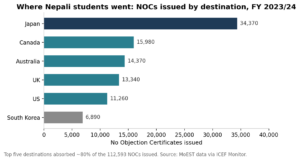
Figure 3. Japan, not a “big four” destination, was the single largest recipient of NOCs in FY 2023/24 — a reminder of how segmented the market is.
The Compliance Gap
For over a decade, regulation moved gently. The 2011 Educational Consultancy Directive and the 2016/17 Consultancy and Language Teaching Directive, both products of government–association dialogue, set the early ground rules. Then in 2025, the Department of Commerce, Supplies and Consumer Protection estimated that as many as 90 percent of consultancies lacked proper licenses and the response was swift with fines, police raids across Kathmandu Valley, and a shift to fully digital registration and monitoring. 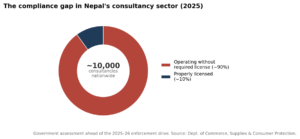
Figure 4. The compliance gap: the government’s 2025 assessment found roughly nine in ten consultancies operating without a license, setting the stage for the ongoing enforcement drive.
In July 2026 the government went further, endorsing the Educational Consultancy, Language Teaching and Preparatory Class (Operation and Management) Regulations alongside new rules for foreign academic programs. The framework imposes a NPR 2.5 million security deposit, annual license renewals, mandatory digital banking channels, government approval for education fairs, and full financial liability on consultancies if students are stranded abroad. FECE Nepal (Federation of Educational Consultancy Entrepreneurs Nepal) operates as a federation of eight member associations – ECAN, the International Education Representatives’ Initiative of Nepal (IERIN), the Nepalese Association of Australian Education Representatives (NAAER), the Japanese Language School Association of Nepal (JALSAN), and the destination and segment specific bodies APCAN, KECAN, AECAN and NEWA, reflecting how the sector has organized along destination lines.
“Most agents are trying to meet the new requirements announced by the Nepali govt. As we work with selected bigger agents in the regions, the majority of them are not that affected by those regulations. Some did share concerns on a few of the requirements, but it is not something which will affect the overall work. The agent organizations like ECAN and others are trying to talk to the govt and get some changes to the policy. Country wise interest for Canada has slightly picked up as Australia has again become very strict and is reporting a high rejection for study permit applications. If it stays the same and Canada’s study permit approval rate gets a bit better, we can expect better outcomes in Jan and May 2027 intakes.” — Ajit Singh, International Recruitment Advisor – South Asia, Fleming College
His point about destinations is central to how consultants earn their keep. Volatility has repeatedly rewarded breadth is what lets a consultancy pivot volume when a policy door closes. Australia’s 2023 tightening cut Nepali VET visas by 96 percent, Canada’s permit caps drove approvals down 64 percent YOY in 2025, and South Korea NOCs remain partially suspended while Nepali enrolments in the UK nearly doubled to over 24,000 in 2024/25. Consultancies that can credibly counsel across eight or more destinations pivot volume when a policy door closes; single-destination shops cannot. 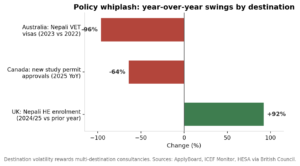
Figure 5. Destination volatility in three data points: consultancies with multi-destination capability can pivot volume when a policy door closes.
Yet for institutional recruiters, the harder question remains partner credibility.
“During my recent visit to Nepal, I also met with a few regional and local agencies. However, I was not fully confident about their processes, particularly with regard to document authenticity and the level of genuine support they would be able to provide to prospective UST students. Additionally, EducationUSA was also unable to provide positive recommendations or feedback on the local agencies we discussed.” — Anju Chopra, International Recruitment Advisor – South Asia, University of St. Thomas
Adjustment, Not Disruption
“Based on my conversations with our recruitment partners in Nepal, the industry appears to be going through a period of adjustment rather than disruption. Most established agencies are already adapting to the new regulatory framework and remain committed to supporting students with the same level of service. In my view, these changes are likely to strengthen the credibility of Nepal’s international education sector over time by encouraging higher professional standards. While there may be some short-term consolidation, the long-term outlook remains positive given the continued strong demand for overseas education among Nepali students.” — Pawandeep Singh Kapoor, Student Recruitment Advisor (South Asia), University of Windsor
The credibility question he raises is precisely what the regulations target and what institutional recruiters still weigh when choosing partners beyond the established few.
Outlook
Three shifts will define 2026–27.
- Regulatory formalization should shrink the informal tail and raise the value of compliant, association-affiliated agencies, the sector’s first meaningful consolidation.
- Destination rebalancing will continue favoring multi-destination consultancies as students pivot toward the UK, Japan, continental Europe and, if approval rates improve, back to Canada.
- With Nepal moving to approve foreign branch campuses at home, consultants may find their next frontier in domestic-international pathway advising rather than pure outbound placement.
Three practical takeaways for partner institutions. First, partner selection is now inseparable from compliance verification — registered, association-affiliated agencies (FECE-member bodies, ECAN’s vetted network) are the only defensible channel, and the current shakeout will make that shortlist stronger, not smaller. Second, the demand is not shrinking; it is redirecting. Australia’s rejection wave is pushing qualified, well-funded applicants toward Canada and Ireland right now, institutions that move in the 2027 intake cycles will meet students already primed to pivot. Third, expect a better market by 2027; fewer but more professional agencies, digital-first transactions, and financial accountability written into law. Nepal is not becoming harder to recruit from, it is becoming safer to. The agencies that built Nepal’s study-abroad movement now face a simpler test than any visa regime. In a market of 10,000 competitors, the survivors will be those who made trust their core product. Sources: Ministry of Education, Science and Technology (Nepal) NOC data; Department of Commerce, Supplies and Consumer Protection (Nepal); ICEF Monitor; ApplyBoard ApplyInsights; British Council Opportunities & Insights; The PIE News; HESA provisional 2024/25 data; ECAN and FECE Nepal publications.