
Why Canada, US, and Ireland institutions should treat Gulf-based expatriate communities as a distinct, resilient recruitment vertical for upcoming intakes.
To most international recruitment teams, the Middle East is still one distant dot on the map, a market visited once a year for an educated fair in UAE. That framing misses what is actually happening on the ground. The region is not primarily a source of students who were born, raised, and schooled in the Gulf’s own national systems. It is home to one of the largest, most durable expatriate populations on earth; tens of millions of South Asian, Filipino, Egyptian, Levantine, and African families who have lived and worked in the GCC for one, two, and now three generations. Their children are, structurally, a captive outbound pipeline for higher education abroad, year after year, regardless of what happens to oil prices or regional politics. For institutions in Canada, the USA, and Ireland, understanding this diaspora dynamic rather than treating the Gulf as an extension of “the Indian market” or “the African market” is fast becoming a competitive advantage in how intakes are planned and staffed.
A market built on citizenship law, not choice
The dynamic is rooted in law, not culture. Nationality statutes across the UAE, Saudi Arabia, Qatar, Kuwait, Bahrain, and Oman make naturalization all but unattainable for long-term expatriate residents, even families who have lived there for decades. A child born in Dubai to Indian or Filipino parents is not Emirati; a grandchild born in Doha to a family that arrived in the 1970s is not Qatari. This is not a temporary policy quirk but a durable structural feature of the region one that pre-answers the “why go abroad” question long before recruitment begins. For these families, the question was never whether a passport-holding country’s education system would eventually be needed, only when, and where.
Recent population data illustrates the scale involved. Foreign nationals make up roughly 88% of the UAE’s population and 85–90% of Qatar’s, with South Asian communities (Indian, Pakistani, Bangladeshi, Nepali, Sri Lankan) forming the largest single bloc, alongside sizeable Filipino, Egyptian, and other Arab and African communities. Saudi Arabia, with over 13 million non-citizen residents, follows a similar pattern. This is not a niche or transient population but a standing base of millions of school-age dependents moving steadily through K-12 systems built on British, American, and IB curricula.

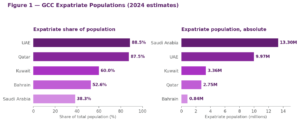
Figure 1 GCC expatriate populations by share of total population and absolute size, 2024 estimates. Sources: national demographic data, 2022–2024.
The two panels above make the strategic point: the UAE and Qatar carry the highest expatriate density, but Saudi Arabia, despite a lower percentage share holds the single largest absolute expatriate population in the Gulf, at an estimated 13.3 million. The market case for a Saudi footprint therefore rests on absolute scale, not density alone.
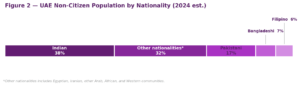
Figure 2 UAE non-citizen population by nationality, 2024 estimates. Source: national demographic data.
As Figure 2 shows, Indian and Pakistani communities alone account for well over half of the UAE’s non-citizen population, with sizeable Bangladeshi and Filipino communities close behind each large enough to warrant its own recruitment channel rather than a shared, generic outreach plan.
Why this cohort recruits differently
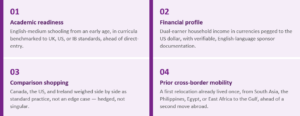
Diaspora families in the Gulf are not equivalent to applicants recruited directly out of Mumbai, Lahore, Manila, or Lagos, and treating them as a subset of those source markets under-serves both the applicant and the institution’s yield strategy.
First, the academic and language profile is different. Students have typically completed English-medium schooling from an early age, often within international curricula designed with UK, US, or IB benchmarks in mind, producing stronger readiness for direct-entry programs and less reliance on pathway or foundation years.
Second, the financial profile is different. Household income is typically dual-earner and drawn in currencies pegged to the US dollar, which insulates affordability from the currency volatility that complicates recruitment from South Asia or parts of Africa. Sponsors are employed professionals with verifiable, English-language documentation, a meaningfully different visa-file profile from a first-generation applicant sponsored entirely from a home-country income.
Third, decision-making is comparison-shopped across multiple destination countries simultaneously, and increasingly hedged. A family in Abu Dhabi weighing Canada, the US, and Ireland side by side is a common pattern, not an edge case, one that rewards a case for relative advantage over an assumption of default preference.
The view from the ground: from destination to outcome
This behavioral shift is precisely what regional teams at Worldwide Educonnect is seeing in real time. According to Pawandeep Singh, Student Recruitment Advisor for South Asia, the GCC is evolving from a recruitment market into a genuine global student-mobility ecosystem and the biggest change is in how students actually decide.
“The GCC is evolving from a recruitment market into a global student-mobility ecosystem, and I believe the biggest shift is in how students make decisions. From my interactions with students, parents, school counsellors, and education partners, students are increasingly becoming ‘outcome shoppers’, looking beyond destination and reputation to compare scholarships, global rankings, co-op and work-integrated learning, employability, affordability, post-study opportunities, and long-term career mobility. The region’s highly diverse and internationally exposed population means there is no longer a single ‘GCC student profile’; aspirations are increasingly shaped by global exposure and family mobility. I see the next phase of MEA (Middle East Asia) mobility becoming multi-directional and highly competitive, with institutions winning not simply by being in a preferred country but by demonstrating a compelling combination of value, outcomes, resilience, and global career opportunity.”
— Pawandeep Singh, Student Recruitment Advisor, University of Windsor
Pawandeep’s read reinforces and sharpens the segmentation point above that there is no single Gulf diaspora buyer, and country brand alone is no longer sufficient currency. Institutions are now being evaluated on a bundle of proof points – scholarship value, ranking, co-op and work-integrated learning, employability outcomes, and post-study career mobility, assembled and compared by the family itself, often across three countries at once.
What shifting policy signals mean for each destination
Current policy conditions are best read in light of this hedging behavior, not in isolation.
Canada’s tightened study permit allocations and post-graduation work permit (PGWP) eligibility changes have introduced real uncertainty, and Gulf-based counsellors and families are well aware of it. Canada retains strong appeal on permanent residency pathways, but automatic first-choice status can no longer be assumed; the stronger case now rests on program-level PGWP eligibility and pathway clarity rather than country brand alone.
The USA continues to hold a strong pull-on STEM, research reputation, and OPT, but heightened visa scrutiny and a less predictable political climate around international students have made Gulf families more risk-averse, often applying to the US as one option within a multi-country portfolio rather than a sole target.
Ireland is the destination gaining the most relative ground in Gulf-based conversations right now, an English-speaking, EU-adjacent option perceived as more stable and less policy-volatile than its larger competitors, with a growing but still under-recognized brand among Gulf diaspora families. Institutions here have a genuine opening to build first-mover awareness before the market matures.
Implications for the upcoming intake cycle
Four shifts define the recruitment landscape for the next intake cycles.
Diaspora segmentation, not a single bloc. Indian, Pakistani, Filipino, Egyptian, and East African communities within the same city carry different preferred fields of study, price sensitivity, and word-of-mouth networks. A single generic “Middle East” campaign underperforms against segmented messaging run through community-specific counsellor and alumni channels.
School-based engagement, not just the fair circuit. The highest-leverage relationships sit with counsellors inside British- and American-curriculum schools in Dubai, Abu Dhabi, Doha, Riyadh, and Kuwait City, engaged early from Year 11 onward rather than through annual fair circuits alone. Timing outreach around GCC academic and cultural calendars, including Ramadan and Eid, matters as much as aligning with the home institution’s own recruitment cycle.
Outcomes, not destination brand, now carry the pitch. With students shopping scholarships, rankings, co-op and work-integrated learning, employability, and post-study career mobility side by side, recruitment materials and counsellor briefings that foreground this evidence explicitly – graduate outcome data, employer partnerships, work-placement structures carry more weight than country or institutional reputation alone.
A distinct diaspora vertical, rather than a subset of South Asian or MENA market plans. Gulf-based recruitment merits its own line in the portfolio, dedicated scholarship messaging that reflects expatriate income profiles and financial documentation, its own agent and counsellor relationships, and its own event calendar. As policy risk concentrates around any single destination country, a well-built Gulf diaspora channel offers a genuinely diversified, resilient source of enrolment growth, one Worldwide Educonnect’s regional presence is positioned to help clients build on directly, ahead of the next intake planning cycle.
Sources: UAE, Qatar, Kuwait, and Bahrain population/expatriate-share figures per national demographic data (2024 estimates); Saudi Arabia non-citizen population per 2022 census. UAE nationality breakdown reflects 2024 estimates; minor communities grouped under “Other nationalities.” Policy context reflects publicly reported Canadian IRCC study permit and PGWP changes, evolving US visa/SEVP conditions, and Irish international education positioning as of August 2026. Practitioner insight courtesy of Pawandeep Singh, Student Recruitment Advisor (South Asia), Worldwide Educonnect.