
What It Means for Institutions in Canada, the US, and Ireland
If you oversee China recruitment for a North American or Irish institution, the issue to watch in 2026 is not application numbers on their own. It is a regulatory shift that is quietly rewriting the rules for education agents in China, landing at a moment when Canada, the US, and Ireland are each experiencing a very different relationship with the Chinese student market.
On July 31, 2026, China’s State Council issued new regulations on exit-entry administration (State Council Decree No. 841), effective September 15. Many Chinese families immediately asked whether studying abroad would become harder. But for institutions abroad, the more important question is different the agent channels you rely on are about to face new compliance requirements, new liabilities, and structural change.
What the new rules change
The regulation contains 19 articles. The most relevant piece for international institutions is a new filing system for agencies that provide study-abroad consulting, document assistance, and related services. New agencies must file within 15 days of establishment. Existing agencies have 90 days until December 14, 2026 to complete filing. Agencies that miss the deadline or operate without filing face fines of up to RMB 50,000, alongside suspension, license revocation, or criminal liability for the most serious violations.
By the numbers: how big is this market, really?
The scale of what’s being brought under regulation is worth sitting with:
- 160,000+ agencies. As of June 2026, more than 160,000 Chinese companies listed exit-entry intermediary services somewhere in their registered business scope, according to Qi Lixin, chairman of the Beijing Migration and Exit-Entry Service Industry Association. Qi has called the figure incomplete, and noted many of these entities were formed after a 2018 deregulation that scrapped the old licensing system entirely.
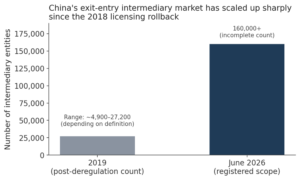
Figure 1. Registered intermediary entities, 2019 vs. June 2026. Sources: academic count (2019); Beijing Migration and Exit-Entry Service Industry Association (2026).
- A market that grew unchecked for seven years. Before 2018, agencies needed a special permit that was valid for five years, subject to annual inspection, and backed by a reserve deposit of at least RMB 500,000 (roughly US $74,000). That entire regime was abolished in autumn 2018, after which anyone with an ordinary business license could enter the market. One academic count taken the following year found anywhere from about 4,900 to over 27,000 immigration intermediaries already operating, depending on definition and 82% of them were less than five years old, underlining how fast the field expanded once the barrier to entry came down.
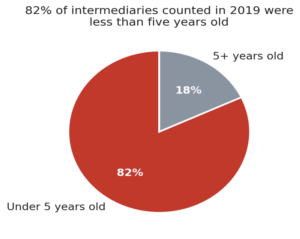
Figure 2. Share of intermediaries under five years old, 2019 count.
- Uneven quality at the bottom of the market. Qi has been unusually candid about what that expansion produced single-person studios, shared-desk operations, domestic shell companies set up by overseas institutions, and firms courting Chinese clients purely through livestreams and remote sales. A minority, by his own account, have no premises, no qualified staff, no capital, no overseas partner, and no internal compliance systems at all.
- Adjacent sector under similar strain. The overlapping travel-agency sector gives a sense of scale too mainland China has roughly 40,000 travel agencies and related intermediary firms, employing an estimated 300,000–400,000 people, and that sector is already contending with its own consolidation pressure as outbound travel patterns shift.
This is the pool of agencies the new filing system now has to sort through separating those with a real legal presence, capital, and premises from those that were never built to survive scrutiny.
The rules draw clear red lines. Agencies may not make false or misleading claims, help clients submit fake documents, sell client data, operate outside their approved scope, or assist cross-border crime. Agencies must also have appropriate capital and premises, and the person in charge must have no record of intentional criminal offences. Penalties now include fines, suspension, license revocation, and even criminal liability.
But the most important line for institutions abroad may be that overseas enterprises and organizations are prohibited from providing exit-entry intermediary services within China.
That directly targets a familiar pitch: “We are the overseas head office, direct operations, no local branch needed.” Under the new rules, such arrangements must either establish a compliant local entity and file properly or they are operating illegally. That changes the risk equation for anyone who works with China-facing agents, regardless of which country the institution sits in.
Three destinations, three different pressures
The timing matters because Canada, the US, and Ireland are each meeting this agent reset from a different starting point.
Canada: a sharp, policy-driven contraction
Canada’s international education sector overall is absorbing a sharp, policy-driven contraction. Statistics Canada’s most recent feasibility study estimates that full-time international enrolment in public postsecondary institutions fell 4% in 2024/2025 and a further 26% in 2025/2026 a two-year decline of roughly 29%, or about 124,000 students, pulling total enrolment back to pandemic-era levels near 300,000. New student cohorts overall are estimated to have dropped 64% in 2025/2026 versus 2023/2024.
But the China-specific picture inside that national contraction is notably different and more resilient than the headline numbers suggest. Study permits issued to Chinese nationals fell 12.6% to 49,125 in 2025, a real decline, but far milder than the collapse in new arrivals system-wide.
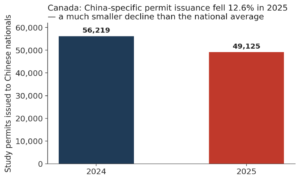
Figure 3. Canada study permits issued to Chinese nationals. Source: IRCC data via StudyTravel Network/The PIE News.
That resilience shows up most clearly in approval rates. While Indian applicants Canada’s largest source country saw approvals crater from about 69% in 2024 to roughly 25–27% in 2025, Chinese applicants’ approval rate held steady and by some measures improved, moving above 65% and reportedly as high as 75% for new study permits granted in 2025.
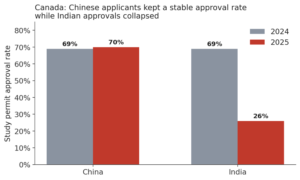
Figure 4. Canada study permit approval rate, China vs. India. Source: BorderPass/IRCC data reported via The PIE News.
China remains Canada’s second-largest source country by student stock, behind India, with roughly 102,000 Chinese students in Canada as of 2023. In other words: Canada’s overall international education sector is contracting sharply, but immigration officials appear to be treating Chinese applications more favorably than most other major source countries which changes the risk calculus for the agent relationships behind those applications.
The United States: a gradual, China-specific decline
The United States has seen a more gradual, multi-year decline concentrated specifically in the China channel. Chinese enrolment fell from a 2019/20 peak of roughly 372,500 students to around 266,000–290,000 in 2024/25, depending on the count, and China lost its long-held position as the top source country to India for the first time since 2009.
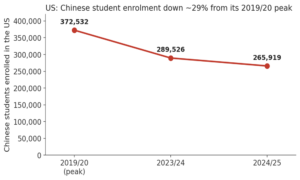
Figure 5. Chinese student enrolment in the US. Source: Institute of International Education / US Department of State, Open Doors Report.
The 2025-26 Open Doors data shows a fifth consecutive annual drop for Chinese students, a roughly 29% cumulative decline from the 2019/20 peak. That trend has been sharpened by policy F-1 visas issued to Chinese nationals fell about 34% between 2024 and 2025 during the peak May-August issuance window, following a May 2025 State Department announcement that it would step up scrutiny and “aggressively revoke” visas for some Chinese students, particularly in STEM fields.
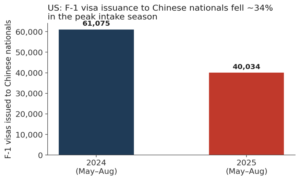
Figure 6. F-1 visas issued to Chinese nationals, May-August intake window. Source: Center for Immigration Studies analysis of US State Department data.
Some of that posture has since softened, but the uncertainty itself has been enough to push families toward other destinations.
Ireland: still growing, with China stable
Ireland is a market still growing overall, where China plays a smaller but stable role. Irish higher education enrolled a record 44,535 non-Irish students in 2024/25, up over 10% year-on-year, and China was the third-largest source country at 9.9% of that total, behind India (20.6%) and the US (13.8%).
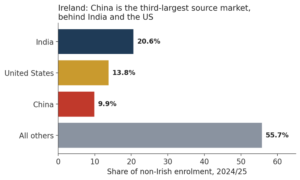
Figure 7. Ireland top source countries as a share of non-Irish enrolment, 2024/25. Source: Ireland’s Higher Education Authority.
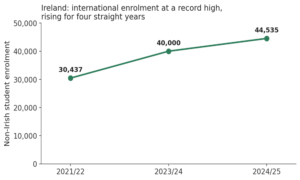
Figure 8. Ireland total non-Irish student enrolment, four-year trend. Source: Ireland’s Higher Education Authority.
Unlike Canada and the US, Ireland’s Chinese enrolment didn’t fall in 2024/25 it essentially levelled off, easing by less than half a percent after several years of volatility. Ireland has been actively marketing itself to Chinese families on the strength of its post-study work visa (Stamp 1G, up to 24 months for master’s and PhD graduates) and its relative affordability versus the UK and US. At the same time, Ireland introduced standardized financial-proof requirements for 2026 and is watching its own overreliance on India, the US, and China, which together account for roughly 44% of its international enrolment.
The common thread is that whichever of these three markets an institution is recruiting into, the agent relationships behind Chinese applications are about to be tested by a regulatory filter that didn’t exist a year ago at exactly the moment each market is either contracting, stabilizing, or trying to grow its China pipeline further.
Why this matters for institutions
First, agent networks need a closer look. Many institutions work with agents that may not have a clear China-based legal entity. Some are overseas-registered companies, some are individuals or studios, and some are subcontractors’ categories that map closely onto the “single-person studio” and “shell company” patterns regulators have flagged. The direct question now is simple: does your contracted agent have a legal presence in China, and can it complete filing? If not, a student dispute or visa problem could leave your institution tangled in a cross-border issue with no accountable local partner.
Second, the “document packaging” model is being squeezed. The rules make truthful and lawful applications a red line, and separately, anyone who obtains a visa, residence permit, or passport through fraud including false materials or statements is now explicitly subject to punishment under China’s Exit and Entry Administration Law and Passport Law. Chinese students are also beginning to realize they cannot hide behind “my agent did it.” This is partly protective for institutions abroad, but it also creates new pressure. If an offer is issued based on weak or falsified documents, the student may still be refused at the visa stage hurting both the student and the institution’s enrolment, whether that visa decision is made in Ottawa, Washington, or Dublin.
Third, “guaranteed admission” and “internal connections” marketing is becoming more dangerous. These claims were always risky. Now they are explicitly prohibited. Institutions that rely on agents making such promises may find themselves associated with regulatory violations and reputational damage a risk that compounds in the US context specifically, where scrutiny of Chinese applicants is already elevated for unrelated visa-policy reasons.
The questions institutions should be asking
The month before September 15 is less a compliance deadline than a window to reassess China strategy and that reassessment looks different depending on the market. Canadian institutions are managing an agent network inside a shrinking overall pipeline. US institutions are managing one inside a politically sensitive, visa-constrained pipeline. Irish institutions are managing one inside a pipeline they’re actively trying to grow. Many institutions built their agent networks in layers: first large national agencies, then especially after the pandemic a wave of independent counsellors and small studios. The next phase will look different again, and in a different way in each market.
Several questions are worth sitting with. Which of your current agents can actually survive a filing regime? Do you know your full China agent map, or has it become unclear? Are large, established agencies still the safest bet, or do they face their own compliance and data pressures? Do independent counsellors and small studios reduce risk through diversification, or increase it through instability?
Above all, who protects the student if something goes wrong? Students and parents are not buying a service; they are choosing a path to your institution. If that path breaks, the institution’s reputation is part of the damage and in a market where every one of these three destinations is competing harder for a Chinese applicant pool that has more options than ever, that reputational cost is more expensive than it used to be.
These questions do not have simple answers. But they point to the same conclusion: China market changes now go beyond recruitment channel management. They touch compliance, brand, student protection, and market understanding.
Work with people who understand the market
The new rules appear to target agencies, but they are also reshaping how institutions in Canada, the US, and Ireland connect with Chinese families. In the past, many institutions saw China through the lens of agent reports and application numbers. The underlying market changes, policy signals, and family concerns were often less visible.
Now that the agent industry is being restructured with well over 160,000 registered entities facing a hard filing deadline of December 14, 2026 institutions need more than a channel that can deliver applications. They need a partner who understands the market on the ground: which agents remain trustworthy, which cooperation models need to change, what Chinese families actually worry about, and how to promote a destination without crossing red lines whether that destination is contracting, contested, or trying to grow.
After September 15, the rules of China’s study-abroad agent market will not be the same. Institutions in Canada, the US, and Ireland alike will need to reassess more than a few agent contracts they will need to reassess their entire China strategy. If that feels uncertain, seeking informed advice is a better first step than waiting for a problem to surface.
Sources: State Council of the People’s Republic of China, Regulations on Exit and Entry Administration (Decree No. 841); Beijing Migration and Exit-Entry Service Industry Association; Statistics Canada, “Estimating the international student population in Canada using administrative data” (May 2026); IRCC arrivals data; Institute of International Education / US Department of State, Open Doors Report; Center for Immigration Studies; Ireland’s Higher Education Authority, Key Facts & Figures 2024/25.